Gynecology119
Example of management of metatarsal bone II tumor originally suspected of having metastatic thyroid follicular cancer 40 and 20 years after total thyroidectomy
Przykład postępowania w przypadku guza II kości śródstopia pierwotnie podejrzewanego jako przerzut raka pęcherzykowatego tarczycy 40 i 20 lat po całkowitej tyroidektomii
Piotr Szkolnicki✉1
1Oddział Urazowo – Ortopedyczny , Pałuckie Centrum Zdrowia , ul. Szpitalna 30, 88-400 Żnin , PL
✉Piotr Szkolnicki
Otrzymano: 24.11.2019Zaakceptowano: 25.07.2021Opublikowano: 26 July 2021
e-ISSN: 2084-2708 (primary version)p-ISSN: 2083-0033 (print version)
Streszczenie
Wstęp
Znanych
jest wiele przyczyn wywołujących zmiany guzowate w śródstopiu
i przodostopiu. We
wszystkich tych przypadkach, trafne rozpoznanie jest kluczowe, aby
wdrożyć dalsze, dedykowane postępowanie diagnostyczno-lecznicze.
Opis przypadku
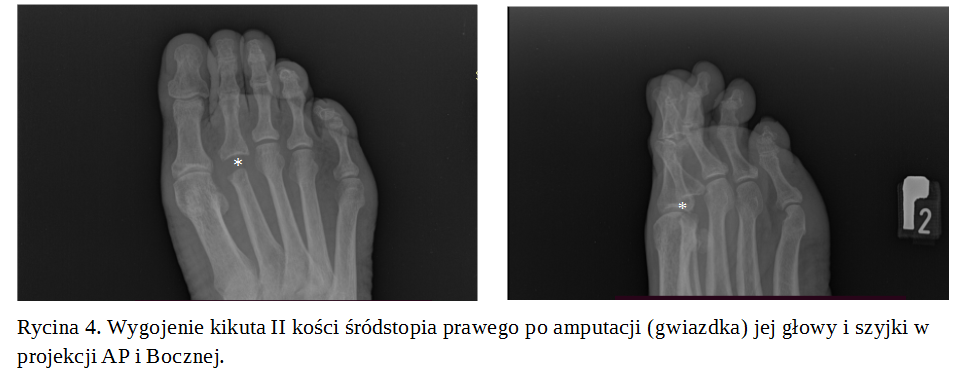 Praca ta opisuje przypadek guza II kości śródstopia u 60-letniej kobiety.
Po jego wycięciu, wyniki pierwszego badania histologicznego wykazały przerzuty FTC. Ze względu na poważne następstwa tego rozpoznania i fakt, iż pacjentka całkowitą tyreoidektomię przechodziła 40 i 20 lat wcześniej zlecono wykonanie badania hist.-pat. i odczynów immunohistochemicznych w trzech niezależnych
ośrodkach.
Tego typu postępowanie wykluczyło obecność FTC, co wyznaczyło
nową linię terapeutyczną , ograniczoną do systematycznych, co pół
roku kontroli.
Praca ta opisuje przypadek guza II kości śródstopia u 60-letniej kobiety.
Po jego wycięciu, wyniki pierwszego badania histologicznego wykazały przerzuty FTC. Ze względu na poważne następstwa tego rozpoznania i fakt, iż pacjentka całkowitą tyreoidektomię przechodziła 40 i 20 lat wcześniej zlecono wykonanie badania hist.-pat. i odczynów immunohistochemicznych w trzech niezależnych
ośrodkach.
Tego typu postępowanie wykluczyło obecność FTC, co wyznaczyło
nową linię terapeutyczną , ograniczoną do systematycznych, co pół
roku kontroli.Wnioski
Jest
to rzadki przypadek w którym pierwotnie rozpoznane przerzuty FTC do
kości
śródstopia
w dalszej diagnostyce nie potwierdziły
się. Dlatego, wykonano zabieg wycięcia tylko guza. W diagnostyce
pooperacyjnej postawiono na wielokrotne, dokładne bad. hist.-pat.
uzyskanych podczas operacji próbek,
co wykluczyło
niekorzystne rozpoznanie. Dzięki temu uniknięto amputacji stopy.
Keywords:Niezidentyfikowany guzII kość śródstopia
Abstract
Introduction
There
are many known causes causing discomfort and tuberous changes in the
metatarsus and forefoot. In
all these cases, accurate diagnosis is crucial to implement further
dedicated diagnostic and therapeutic procedures.
Case Report
This
work describes the case of metatarsal II tumor in a
60-year-old woman. After its excision, the results of the first
histological examination showed FTC metastases. Due to the serious
consequences of this diagnosis and the fact that the patient
underwent complete thyroidectomy 40 and 20 years earlier, a
histopathological examination and immunohistochemical reactions was
ordered in three independent centers. This type of procedure excluded
the presence of FTC, which set a new therapeutic line, limited to
systematic, semi-annual inspections.
Conclusions
This
is a rare case in which the FTC metastases to the metatarsal bone
that were initially diagnosed were not confirmed in further
diagnostics. Therefore, only tumor resection was performed. The
postoperative diagnosis was focused on multiple, thorough hist.-pat.
examinations samples obtained during surgery, which ruled out
unfavorable recognition. Thanks to this, amputation of the foot was
avoided.
Keywords:Unidentified tumorII Metatarsal Bone
References
- 1.Saumya Pandey, Pratima Khare, Shailendra Khare. GIANT CELL TUMOR OF THE SECOND METATARSAL: A CASE REPORT AND BRIEF REVIEW OF LITERATURE. International Journal of Scientific Research. 2019;8(1):492-493
- 2.Kaste SC, Strouse PJ, Fletcher BD, Neel MD. Benign and malignant bone tumors. Slovis TL (ed) Caffey’s pediatric diagnostic imaging. 2008:2912–2969. Mosby Elsevier, Philadelphia
- 3.Vanel D, Ruggieri P, Ferrari S, Picci P, Gambarotti M, Staals E et al. The incidental skeletal lesion: ignore or explore?. Cancer Imaging. 2009;9 Spec No A(Special issue A):38–43
- 4.Dana I. Dumitriu, Renaud Menten, Philippe Clapuyt. Pitfalls in the diagnosis of common benign bone tumours in children. Insights Imaging. 2014;5:645–655
- 5.Krzakowski M., Warzycha K. et al. Zalecenie postępowania diagnostyczno – terapeutycznego w nowotworach złośliwych – 2013. Via Medica. 2013:457–481
- 6.F. Pacini, M. Schlumberger, H. Dralle et al. European consensus for the management of patients with differentiated thyroid carcinoma of the follicular epithelium. European Journal of Endocrinology. 2006;vol. 154(no. 6):787–803
- 7.Anastasios Christodoulou, Avraam Ploumis, George Karkavelas, Ioannis Terzidis, Ioannis Tsagias. A Rare Case of Juxtaarticular Osteoid Osteoma of the Calcaneus Initially Misdiagnosed as Juvenile Chronic Arthritis. ARTHRITIS & RHEUMATISM. 2003;vol. 48(no. 3):776–779
- 8.Mohammad Jawad H. Rahal , Karam M. Karam, Selim M. Nasser, Jihad A. Daher, Hicham G. Abdel Nour, Alexandre H. Nehme, and Ramzi C. Moucharafieh. Calcaneus Metastasis from Follicular Thyroid Carcinoma 12 Years after Total Thyroidectomy. Hindawi, Case Reports in Orthopedics. 2018;vol. 2018(Article ID 5281452):5 pages
- 9.Mahmoudreza Tahamtan, MaralMokhtari, Sara Pakbaz, and Mehdi Tahamtan. Occult Follicular Thyroid Carcinoma Presenting as a Frontal Bone Metastasis: A Case Report. Hindawi Publishing Corporation, Case Reports in Medicine. 2012;vol. 2012(Article ID 678935):3 pages
- 10.M. M. Muresan, P. Olivier, J. Leclère et al. Bone metastases from differentiated thyroid carcinoma. Endocrine Related Cancer. 2008;vol.15(no.1):37-49
- 11.M. Sitarska, R. Czarnecki, L. Kokoszka, W. Witkiewicz. Chrzęstniakomięsak kości nadgarstka — opis przypadku. © PrzypadkiMedyczne.pl. 2015;vol.76:349–355
- 12.R. Kalra, R. Pawar, S. Hasija, A. Chandna, M. Sankla, and C. Malhotra. Frontal bone metastasis from an occult follicular thyroid carcinoma: diagnosed by FNAC. Journal of Cytology. 2017;vol.34(no.1):59-61
- 13.S. N. Koppad and V. B. Kapoor. Follicular thyroid carcinoma presenting as massive skull metastasis: a rare case report and literature review. Journal of Surgical Technique and Case Report. 2012;vol.4(no.2):112-1114
- 14.G. Çoban, E. Yildirim, K. Gemici, and H. Erinanç. MRI findings of lumbosacral metastasis from occult follicular thyroid cancer: report of a case. Surgery Today. 2014;vol.44(no.3):553-557
- 15.D. J. Jo, J. K. Jun, and S. M. Kim. Total en bloc lumbar spondylectomy of follicular thyroid carcinoma. Journal of Korean Neurosurgical Society. 2009;vol.45(no.3):188-191
- 16.G. Zettinig, B. J. Fueger, C. Passler et al. Long-term follow-up of patients with bone metastases from differentiated thyroid carcinoma - surgery or conventional therapy. Clinical Endocrinology. 2002;vol.56(no.3):377-382
- 17.Y. Ogawa, T. Sugawara, H. Seki, and T. Sakuma. Thyroid follicular carcinoma metastasized to the lung, skull, and brain 12 years after initial treatment for thyroid gland-case report. Neurologia medico-chirurgica. 2006;vol.46(no.6):302-305
- 18.A. Mishra, C. Kumar, G. Chand et al. Long-term outcome of follicular thyroid carcinoma in patients undergoing surgical intervention for skeletal metastases. World Journal of Surgery. 2016;vol.40(no.3):562-569
- 19.J. D. Lin, S. F. Lin, S. T. Chen, C. Hsueh, C. L. Li, and T. C. Chao. Long-term follow-up of papillary and follicular thyroid carcinomas with bone metastasis. PloS One. 2017;vol.12(no.3)
- 20.R. L. Satcher, P. Lin, N. Harun, L. Feng, B. S. Moon, and V. O. Lewis. Surgical management of appendicular skeletal metastases in thyroid carcinoma. International Journal of Surgical Oncology. 2012;vol.2012(Article ID 417086):12 pages
- 21.M. T. McCarthy, H. Ebrahem, Z. Aibdeen, P. A. Hodnett, E. Mulcahy, and N. Osman. Prostate cancer metastasis to calcaneus: a solitary lesion at an atypical site, dormant for more than 10 years. JRSM Open. 2016;vol.7(no.10)
- 22.Zbigniew Jabłonowski. Rak pęcherza moczowego – epidemiologia, diagnostyka i leczenie w XXI wieku. Folia Medica Lodziensia. 2013;tom 40(nr 1):31-52 (38)
- 23.Krystyna Serkies, Jacek Jassem. Mięsaki trzonu macicy. Onkologia w Praktyce Klinicznej. 2010;tom 6(nr 1):7-13 (8)
- 24.T. P. Manolitsas, J. M. Fowler, R. A. Gahbauer, and N. Gupta. Pain in the foot: calcaneal metastasis as the presenting feature of endometrial cancer. Obstetrics and Gynecology. 2002;vol.100(5 Part 2):1067-1069