Surgery104
Acquired cystic disease associated renal cell carcinoma - new entity in classification WHO 2016. Report of two cases detected at an early stage of development.
Rak nerki związany z nabytą torbielowatością nerek - nowa jednostka w klasyfikacji WHO 2016. Opis dwóch przypadków wykrytych na wczesnym etapie rozwoju.
Ewa Gawełek✉1Bogna Drozdzowska1
1Katedra i Zakład Patomorfologii, Wydział Lekarski z Oddziałem Lekarsko-Dentystycznym w Zabrzu, Śląskiego Uniwersytetu Medycznego w Katowicach, 3 Maja 13-15, 41-800 Zabrze
✉Ewa Gawełek
Otrzymano: 22.08.2017Zaakceptowano: 25.05.2018Opublikowano: 30 May 2018
e-ISSN: 2084-2708 (primary version)p-ISSN: 2083-0033 (print version)
Streszczenie
Wstęp
Rak nerki związany z nabytą torbielowatością nerek (ang. Acquired cystic disease associated renal cell carcinoma - ACD-RCC ] rozwija się wyłącznie u pacjentów z nabytą torbielowatością nerek na podłożu schyłkowej niewydolności nerek [SNN]. Do cech charakterystycznych nowotworu należą: utkanie sitowate, z tworzeniem drobnych, pustych przestrzeni międzykomórkowych i wewnątrzcytoplazmatycznych o różnej wielkości, obecność w zrębie kryształów szczawianu wapnia, obecność komórek z obfitą, kwasochłonną cytoplazmą oraz jądrami z wyraźnymi jąderkami.
Opis przypadku
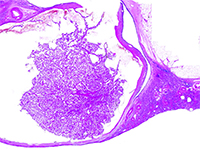 Praca przedstawia 2 przypadki ADC-RCC: u 34-letniego pacjenta z resekcją nerki z powodu obecności torbieli zakwalifikowanej do III/IV kategorii w skali Bośniak oraz u 42-letniej kobiety z przewlekłą niewydolnością nerek, u której nowotwór stanowił przypadkowe znalezisko w badaniu pooperacyjnym.
Wnioski
RCC jest nową jednostką wprowadzoną do klasyfikacji WHO w 2016 roku. Wcześniej był diagnozowany jako rak brodawkowaty z powodu podobnego profilu immunohistochemicznego oraz molekularnego. ACD-RCC rozwija się zwykle w ścianie torbieli i ma tendencje do wystepowania wieloogniskowego. Regularne badania kontrolne u pacjentów zSNN są niezbędne do wczesnego wykrycia guza, co jest związane z dobrym rokowaniem klinicznym.
Keywords:Rak nerki związany z nabytą torbielowatością nerek
Abstract
Introduction
Acquired cystic disease associated renal cell carcinoma [ACD-RCC] develops exclusively in patients with acquired cystic disease [ACDK] of kidney due to end stage renal disease. The tumor shows sieve - like architecture because of intra- and intercellular microlumen formation, presence of calcium oxalate crystals in the stroma, cells have abundant eosiniphilic cytoplasm and prominent nucleoli.
Case Report
paper presents two cases of ACD - RCC in 34-year old men with kidney resection due to presence of cyst described as group III/IV in Bośniak scale and in 42-year old woman with chronic renal failure and tumor found incidentally after the surgery.
Conclusions
RCC is a new entity introduced in WHO classification 2016. In the past it was described as papillary carcinoma because of similar immunohistochemical and molecular profile. ACD-RCC develops usually in cyst wall, and tends to be multifocal. Periodic follow - ups in patient with end stage renal disease are essencial for early detection of tumor, what is associated with good clinical prognosis
Keywords:Acquired cystic disease-renal cell carcinoma
References
- 1.Dalahunt B., John R, Montironi R., Egevad L. Advances in renal neoplasia. recommendations from the 2012 International Society of Urological Pathology Consensus Conference. Urology. 2014;83((5)):969-74
- 2.Hosseini M, Antic T, Paner GP, Chang A. Pathologic spectrum of cysts in end-stage kidneys: Possible precursors to renal neoplasia. Hum Pathol. 2014;45((7)):1406–13
- 3.. Rivera M, Tickoo SK., Sagi A, Lin O. Cytologic findings of acquired cystic disease-associated renal cell carcinoma: a raport of two cases. Diagn Cytopathol. 2008;36((5)):344-7
- 4.Bostwick DG, Cheng L. 2010. Urologic Surgical Pathology. 2014;1(Neoplasms of kidney). Elsevier
- 5.Truong LD, Choi YJ, Shen SS, Ayala G, Amato R, Krishnan B. Renal cystic neoplasms and renal neoplasms associated with cystic renal diseases: Pathogenetic and molecular links. Adv Anat Pathol. 2003;10((3)):135–59
- 6.. Bhatnagar R., Alexiev BA. Renal cell carcinomas in end – stage kidneys: A clinicopathological study with emphasis on clear-cell papillary renal-cell carcinoma and acquired cystic kidney disease-associated carcinoma. Int J Surg Pathol. 2012;20((1)):19-28
- 7.Tajima S, Waki M, Doi W Hayashi K, Takenaka S, Fukaya Y, Kimura R. Acquired cystic disease-associated renal cell carcinoma with a focal sarcomatoid component: Report of a case showing more pronounced polysomy of chromosomes 3 and 16 in the sarcomatoid component. Int Pathol. 2015;65((2)):89-94
- 8.Moch H, Humprey PA, Ulbright TM. WHO Classification of tumors of the urinary system and male genital organs. Tumors of the kidney. 2016;1(rozdział: Tumors of kidney). International Agency for Research on Cancer
- 9.Lewicki A, Jakubowski W, Pypno W, Kidawa A. Zhou XJ. Ultrasonografia i inne metody obrazowe w różnicowaniu zmian torbielowatych nerek. Przegl Urolog. 2009;6((58)):23-25
- 10.Rao Q, Xia QY, Cheng L. Zhou XJ. Molecular genetics and immunohistochemistry characterization of uncommon and recently described renal cell carcinomas. Chin j Cancer Res. 2016;28((1)):29-49
- 11.Pan CC, Chen YJ, Chang LC Chang YH, Ho DM. Immunohistochemical and molecular genetic profiling of acquired cystic disease-associated renal cell carcinoma. Histopathology. 2009;55((2)):145–153
- 12.Kuroda N, Shiotsu T, Hes O Michal M, Shuin T, Lee GH. Acquired cystic disease-associated renal cell carcinoma with gain of chromosomes 3, 7, and 16, gain of chromosome X, and loss of chromosome Y. Med Mol Morphol. 2010;43(4):231-4
- 13.Kuroda N, Yamashita M, Kakehi Y, Hes O, Michal M, Lee GH. Acquired cystic disease-associated renal cell carcinoma: An immunohistochemical and fluorescence in situ hybridization study. Med Mol Morphol. 2011;44((4)):228–32
- 14.Kuroda N, Tamura M, Hamaguchi N, Mikami S, Pan CC, Brunelli M, Martignoni G, Hes O, Michal M, Lee GH. Acquired cystic disease - associated renal cell carcinoma with sarcomatoid change and rhabdoid features. Ann Diagn Pathol. 2011;15((6)):462–6