Interna№ 120
Infekcja SARS-CoV-2 u chorego na raka gruczołowego z mutacją w genie EGFR leczonego erlotynibem – opis przypadku
SARS-CoV-2 infection in a patient with adenocarcinoma with a mutation in the EGFR gene treated with erlotinib - a case report
Justyna Cabaj✉1Marta Lato1Kinga Sobota1Anna Toczek1Paweł Krawczyk2Robert Kieszko2Izabella Drogoń2Julia Bargieł1
1Studenckie Koło Naukowe przy Katedrze i Klinice Pneumonologii, Onkologii i Alergologii Uniwersytetu Medycznego w Lublinie; 20-090 Lublin ul. Jaczewskiego 8
2Katedra i Klinika Pneumonologii, Onkologii i Alergologii Uniwersytetu Medycznego w Lublinie; 20-090 Lublin ul. Jaczewskiego 8
Otrzymano: 05.05.2021Zaakceptowano: 07.12.2021Opublikowano: 08 grudnia 2021
e-ISSN: 2084-2708 (wersja pierwotna)p-ISSN: 2083-0033 (wersja drukowana)DOI: 10.67417/medcasereports.120
Streszczenie
Wstęp
Globalna pandemia COVID-19 stanowi wyzwanie terapeutyczne dla opieki zdrowotnej, zwłaszcza wśród chorych onkologicznych. Pacjenci powyżej 60 roku życia z niedrobnokomórkowym rakiem płuca są szczególnie narażeni na infekcję COVID-19 i cięższy przebieg choroby.
Opis przypadku
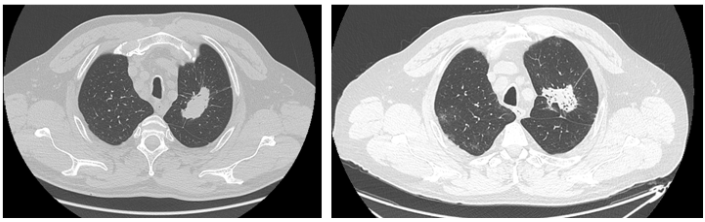 Publikacja zawiera opis przypadku 65-letniego chorego z rozpoznanym rakiem gruczołowym płuca z mutacją aktywującą L858R w eksonie 21 genu EGFR, zakwalifikowanego do leczenia inhibitorem kinazy tyrozynowej EGFR – erlotynibem, u którego wykryto infekcję wirusem SARS-CoV-2. W związku z zakażeniem postanowiono wstrzymać leczenie na okres 2 tygodni. Przejście zakażenia SARS-CoV-2 nie spowodowało destabilizacji choroby. Łagodny przebieg infekcji spowodował, że nie doszło u chorego do cięższych powikłań wymagających hospitalizacji, wobec czego nie było podstaw do odstawienia na dłuższy czas terapii IKT.
Wnioski
Zastosowanie terapii ukierunkowanej molekularnie lub immunoterapii przekłada się na remisję choroby i długotrwałe przeżycie chorych z nowotworem. W przypadku infekcji COVID-19 u większości pacjentów z rakiem zaleca się wstrzymanie terapii. Jednak ryzyko progresji raka sprawia, że decyzja, czy należy przerwać leczenie pozostaje dyskusyjna.
Słowa kluczowe:rak płucaCOVID-19mutacja EGFRerlotynib
Abstract
Introduction
The global COVID-19 pandemic poses a therapeutic challenge for healthcare, especially among cancer patients. Patients over 60 years of age with non-small cell lung cancer are particularly at risk of COVID-19 infection and a more severe course of the disease.
Case Report
The publication describes the case of a 65-year-old patient with diagnosed lung adenocarcinoma with a L858R activating mutation in exon 21 of the EGFR gene, qualified for treatment with the EGFR tyrosine kinase inhibitor - erlotinib, who was infected with SARS-CoV-2 virus. Due to the infection, it was decided to suspend the treatment for a period of 2 weeks. The passage of SARS-CoV-2 infection did not destabilize the disease. The mild course of the infection prevented the patient from developing more severe complications requiring hospitalization, so there was no reason to discontinue IKT therapy for a longer period of time.
Conclusions
The use of molecularly targeted therapy or immunotherapy translates into disease remission and long-term survival of cancer patients. In the case of infection COVID-19 in the majority of cancer patients, it is recommended to suspend therapy. However, the risk of cancer progression makes the decision whether or not treatment should be discontinued.
Keywords:lung cancerCOVID-19EGFR mutationerlotinib
Piśmiennictwo
- 1.Wojciechowska U, Olasek P, Czauderna K, Didkowska J. Nowotwory złośliwe w Polsce w 2014 roku. Centrum Onkologii - Instytut. 2016
- 2.Bade BC, Dela Cruz CS. Lung Cancer 2020: Epidemiology, etiology, and prevention. Clin Chest Med. 2020:1-24
- 3.Siddiqui F, Siddiqui AH. Lung cancer. 2020
- 4.Díaz-Serrano A, Gella P, Jiménez E, et al. Targeting EGFR in lung cancer: current standards and developments. Drugs. 2018:893-911
- 5.Clark SB, Alsubait S. Non-small cell lung cancer. 2021
- 6.Shah R, Lester JF. Tyrosine kinase inhibitors for the treatment of EGFR mutation-positive non-small-cell lung cancer: a clash of the generations. Clin Lung Cancer. 2020:e216-e228
- 7.Sha Z, Chang K, Mi J, et al. The impact of the COVID-19 pandemic on lung cancer patients. Ann Palliat Med. 2020:3373-3378
- 8.Addeo A, Obeid M, Friedlaender A. COVID-19 and lung cancer: risks, mechanisms and treatment interactions. J Immunother Cancer. 2020
- 9.Rogado J, Pangua C, Serrano-Montero G, et al. Covid-19 and lung cancer: a greater fatality rate?. Lung Cancer. 2020:19-22
- 10.Luo J, Rizvi H, Preeshagul I, et al. COVID-19 in patients with lung cancer. Ann Oncol. 2020:1386-1396
- 11.Garassino MC, Whisenant JG, Huang LH, et al. COVID-19 in patients with thoracic malignancies (TERAVOLT): first results of an international, registry-based, cohort study. Lancet Oncol. 2020:914-922
- 12.Zhang H, Xie C, Huang Y. Treatment and outcome of a patient with lung cancer infected with severe acute respiratory syndrome Coronavirus-2. J Thorac Oncol. 2020:e63-e64
- 13.Soria JC, Ohe Y, Vansteenkiste J, et al. Osimertinib in untreated EGFR-mutated advanced non-small-cell lung cancer. N Engl J Med. 2018:113-125
- 14.Weisberg E, Parent A, Yang PL, Sattler M, Liu Q, Liu Q, Wang J, Meng C, Buhrlage SJ, Gray N, Griffin JD. Repurposing of Kinase Inhibitors for Treatment of COVID-19. Pharm Res. 2020
- 15.Lupberger J, Zeisel MB, Xiao F, et al. EGFR and EphA2 are host factors for hepatitis C virus entry and possible targets for antiviral therapy. Nat Med. 2011
- 16.Ueki IF, Min-Oo G, Kalinowski A, et al. Respiratory virus-induced EGFR activation suppresses IRF1-dependent interferon λ and antiviral defense in airway epithelium. J Exp Med. 2013
Powiązane opisy przypadków

Napisz komentarz
Komentarze (0)
Brak komentarzy.