Migracja złamanego drutu Kirchnera po zespoleniu zwichniętego stawu barkowo-obojczykowego – opis przypadku.
Migration of a Kirschner wire used in fixation of acromioclavicular joint dislocation – case report.
11. Department of Orthopedics and Traumatology, City Hospital in Zabrze, Zamkowa 4, 41-803 Zabrze, Poland 2. Department of Computer Biomedical Systems, University of Silesia, Institute of Computer Science, Będzinska 39, 41-200 Sosnowiec, Poland
2Department of Orthopedics and Traumatology, City Hospital in Zabrze, Zamkowa 4, 41-803 Zabrze, Poland
Streszczenie
Wstęp
Opis przypadku
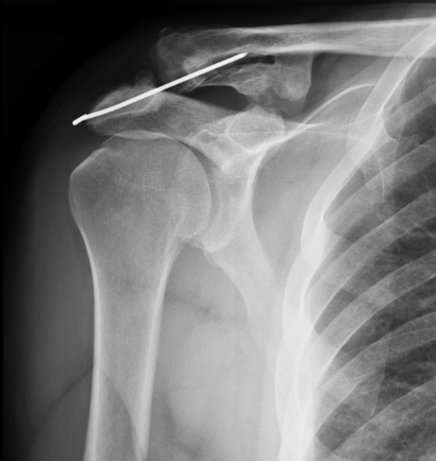 U 53-letniego pacjenta rozpoznano zwichnięcie III stopnia stawu barkowo obojczykowego. Zwichnięty staw ustabilizowano dwoma drutami Kirschnera. Po dwóch latach, podczas operacji reinsercji zerwanej głowy długiej prawego mięśnia dwugłowego ramienia usunięto jeden drut Kirschnera. Po niespełna czterech latach od pierwszego zabiegu pacjent zgłosił się do poradni ortopedycznej podając ból okolicy nad prawą łopatką. Rozpoznano pęknięcie pozostałego drutu Kirschnera, z migracją jego części bliższej do tkanek miękkich okolicy nadłopatkowej. W trybie pilnym chirurgicznie usunięto obydwa fragmenty drutu. Po operacji dolegliwości bólowe pacjenta ustąpiły.
Wnioski
Abstract
Introduction
Case Report
Conclusions
Piśmiennictwo
- 1.Gaździk T. Ortopedia i traumatologia. 2010. Wydawnictwo Lekarskie PZWL
- 2.Liberski J, Ficek K. Kirschner wire migration from the clavicle to the cervical spine. International Journal of Case Reports and Images. 2013(4(6)):308–311
- 3.Cooper G,Herrera JE. Manual of Musculoskeletal Medicine. 2015. Lippincott Williams & Wilkins
- 4.Struhl S,. Double Endobutton Technique for Repair of Complete Acromioclavicular Joint Dislocations. Techniques in Shoulder and Elbow Surgery. 2007:175-179
- 5.Smith TO, Chester R, Pearse EO, Hing CB,. Operative versus non-operative management following Rockwood grade III acromioclavicular separation: a meta-analysis of the current evidence base. J Orthop Traumatol. 2011:19–27
- 6.O. Gulcan, A. T. Sezgin, B. Bolat, R. Turkoz,. Right ventricular penetration and cardiac tamponade as a late complication of Kirschner wire placement in the sternoclavicular joint. Interact. Cardiovasc. Thorac. Surg. 2005:295–6
- 7.R. Durpekt, J. Vojácek, R. Lischke, J. Burkert, J. Spatenka,. Kirschner wire migration from the right sternoclavicular joint to the heart: a case report. Heart Surg. Forum. 2006:E840–2
- 8.J. Leppilahti, P. Jalovaara. Migration of Kirschner wires following fixation of the clavicle - a report of 2 cases. Acta Orthop. Scand. 1999:517-9
- 9.W. Petersen, M. Wellmann, S. Rosslenbroich, T. Zantop,. Minimalinvasive Akromioklavikulargelenkrekonstruktion (MINAR). Oper. Orthop. Traumatol. 2010:52–61
Powiązane opisy przypadków
Postępowanie w dystocji barkowej u pacjentki rodzącej do wody - studium przypadku
01.12.2022
Izolowany nerwiakowłókniak splotowy ręki: opis dwóch przypadków. Propozycje diagnostyki i leczenia.
30.08.2022
Mastektomia i jednoczasowa rekonstrukcja piersi u chorej na mięsaka gruczołu po przebytym skojarzonym leczeniu oszczędzającym z powodu raka
05.01.2022
Komentarze (0)
Brak komentarzy.